Pages

Live blogging Feed

Thursday, November 04, 2010

Skype 5.0 Beta for Mac finally available, includes group video calling

Skype 5.0 Beta for Mac finally available, includes group video calling: "

Well, finally! That's right, you no longer have to be jealous of your friends who've all been group video calling using Skype 5.0 for Windows for months -- Skype's new Beta 5.0 for Mac finally brings the ability to video chat with up to ten of your Skype contacts to OS X client. Obviously, that's the premiere feature of the new release, but the software has also been retooled to mesh more with the look and feel of the OS -- there's even a cover flow-like contact window -- and a new pop-out call control bar that can be moved anywhere on the screen or be kept open while in another program. We just downloaded the beta and it's certainly a lot better looking than the previous version, but we also noticed that it integrated our Mac address book right into the contacts pane and when we initiated a call it automatically muted the song we were listening to in iTunes. Naturally, we went searching for that Facebook integration that we just saw rolled out in the Windows version, but it's nowhere to be found at the moment, and Skype tells us it's focusing on video and UI tweaks for the Mac version. We could go on and on about the new software, but it's available for download at the source link below, so run along and throw your own virtual cupcake party!

Continue reading Skype 5.0 Beta for Mac finally available, includes group video calling

Skype 5.0 Beta for Mac finally available, includes group video calling originally appeared on Engadget on Thu, 04 Nov 2010 13:36:00 EDT. Please see our terms for use of feeds.

Permalink | sourceSkype | Email this | Comments


"

Skyfire browser brings Flash to iPhone – briefly

Skyfire browser brings Flash to iPhone – briefly: "Skyfire launched a mobile browser which enables iPhone users to view Flash video content via the Apple App Store, although its availability was short-lived when demand meant the infrastructure supporting the product was overwhelmed."

CK Joins the 3D Camp with Designer 3D Glasses/Sunglasses

CK Joins the 3D Camp with Designer 3D Glasses/Sunglasses: "
CK Joins the 3D Camp with Designer 3D Glasses/Sunglasses


First Oakley, then Gucci, and now CK will be joining the 3D fray with the rise of 3D televisions inside home theaters and living rooms with its own branded designer shades. Calvin Klein is said to be offering three different styles of 3D glasses each for men and women, all of which will be RealD certified. The glasses can serve as 3D for indoors use or as regular sunglasses with UV protection for when you're roaming about under the sun thanks to the photochromic coating and M3D circular polarized lens tech. 'With Marchon3D's M3D technology and ck Calvin Klein Eyewear's sleek, fashion-forward design, we are providing consumers the best 3D-enabled sunglass on the market,' said Claudio Gottardi, President of Marchon and CEO of Marchon International. 'Having infused technology and fashion only raises the bar in the 3D eyewear field and Marchon is excited and proud to lead the industry.' CK notes that the company's M3D line of glasses are not to be confused with other 3D glasses on the market in that CK's M3D offerings can be used as both 3D goggles and as sunglasses and will retail for $180 when launched in December.


Permalink: CK Joins the 3D Camp with Designer 3D Glasses/Sunglasses from Ubergizmo | Hot: Macbook Air Review,
Epic 4G Review


"
Qualcomm to Ride LTE Wave with Dual-Core Snapdragon Tablet Offerings

Qualcomm to Ride LTE Wave with Dual-Core Snapdragon Tablet Offerings: "
Qualcomm to Ride LTE Wave with Dual-Core Snapdragon Tablet Offerings


While Qualcomm won't be releasing any tablets of its own--that we know of--the company did outline its ambitious plans for tablets in 2011 as it intends on riding the wave of the emerging LTE 4G market in the U.S. and abroad. According to the company's earnings conference call, Qualcomm is actively engaged in ten tablet development efforts. The company didn't state which specific companies or company that it is working with for the tablets, but we should see at least 10 tablets for 2011. In terms of tablets, Qualcomm hinted at dual-core chips for use in the larger slate-based mobile computing devices.


Permalink: Qualcomm to Ride LTE Wave with Dual-Core Snapdragon Tablet Offerings from Ubergizmo | Hot: Macbook Air Review,
Epic 4G Review


"
Samsung Announcing Flexible AMOLED Displays in Japan

Samsung Announcing Flexible AMOLED Displays in Japan: "
Samsung Announcing Flexible AMOLED Displays in Japan


Samsung is said to be announcing a flexible, durable 4.5-inch WVGA resolution AMOLED display in Japan Flat Panel Display Convention next week. The panels are said to offer the same vividness and crispness as those used on the Galaxy S series smartphones, making us believe that they may possibly be a Super AMOLED panel. These displays can bend and wrap around without distortion or breaking, and could possibly open up the gates to new forms of consumer electronics devices and applications. In the past, however, flexible displays have not been received well by user focus group; an e-reader company had stated before that it had utilized a flexible e-ink display, but consumers were not confident that the display would withstand daily use so the company added a hard coating to the flexible e-ink display. Additionally, Taiwan's ITRI also showed off a flexible color AMOLED screen recently as well.


Permalink: Samsung Announcing Flexible AMOLED Displays in Japan from Ubergizmo | Hot: Macbook Air Review,
Epic 4G Review


"

Google Instant Now on iPhone and Android Devices

Google Instant Now on iPhone and Android Devices: "
Google Instant Now on iPhone and Android Devices


Google has now ported its Instant search capabilities to iOS and Android devices. Google Instant could be accessed without any additional software and install. All you have to do is to navigate to Google.com on your mobile browser--either Safari or Android Browser--and start typing in your search query in the search field. According to Google, 'Google Instant makes search faster by displaying not just predictions but actual search results as you type. This saves valuable time on a desktop browser, but wouldn't it be great to have Google Instant on mobile devices, where each keystroke and page load is much slower and you frequently have just a moment to find the information you need?' You can watch it in action in the video after the jump.


Permalink: Google Instant Now on iPhone and Android Devices from Ubergizmo | Hot: Macbook Air Review,
Epic 4G Review


"

China Unicom renames its application storefront to Wostore

China Unicom renames its application storefront to Wostore: "

wostore China Unicom renames its application storefront to Wostore

Similarly to China Mobile which has its own flavor of Android (OPhone), China Unicom has been working on UPhone and the accompanying Ustore application market. That store now has a new name, supporting not only Android, but other mobile platforms as well.

The new name is Wostore, with WO coming from the brand of the carrier’s 3G offering. From what we’ve seen (Wostore can already be accessed via the web), the store supports quite a few handsets and has already attracted few thousand developers.

The introduction of an app store is seen as part of China Unicom’s strategy to embrace smartphones. The carrier is known as Apple’s partner, but it also offers some BlackBerry models.

In addition to China Unicom, two other operators in the world’s fastest growing economy, China Mobile and China Telecom, also have mobile app stores of their own with (obviously) China Mobile leading the way, both in terms of number of developers and apps…

[Via: MobileBusinessBriefing]

Copyright © 2005-2010 IntoMobile. All rights reserved. Use of this feed is limited to personal use. Portions of this feed may be used with attributions, however, publishing of this feed in its entirety for public or commercial use and/or misrepresentation by a third party is not allowed. p9jxMDO3f0KB

"

Chinese invent a single chip solution that lets a mobile phone use up to 4 SIM cards simultaneously

Chinese invent a single chip solution that lets a mobile phone use up to 4 SIM cards simultaneously: "
SIMcards Chinese invent a single chip solution that lets a mobile phone use up to 4 SIM cards simultaneously

Chinese firm Spreadtrum Communications has announced their SC6600L6 single chip solution that lets phone manufacturers build devices that can support up to 4 SIM cards, and best of all those SIM cards can all be active. This is good news for men who cheat on their wives, people who deal drugs, or … that’s all I can really think of. When news of the first triple SIM card device broke on the internet, I thought it was a joke, that no one would ever want such a product. Looks like even 3 SIM cards isn’t enough for some people, and they need that 4th one, just in case.

“The Quad-SIM solution is another invention resulting from our continuing effort of technology innovation.” said Dr. Leo Li, Spreadtrum’s President and CEO, “Spreadtrum is also the inventor of the world’s first dual SIM and triple SIM solution. We are dedicated to increasing the value of our products by providing attractive features to our customers. The Quad-SIM solution offers unparalleled flexibility for multiple-operator-market and business users who need to keep constant connection.”

Out of the top 5 phone vendors, only Samsung and Nokia seem to be making devices that tailor to the multi SIM market. It’s a big thing in places like China, Africa, Russia, India, countries where people count every penny they earn and will find whatever elaborate solution they need to, just so they can have enough cash left over for food and some sort of personal entertainment. Who is to blame here, operators for charging too much for their services, or governments for letting countries have such a wide gap between the rich and the poor? It’s silly to politicize a press release for a chip that will go in a device that will probably never reach American or European shorts, but you’ve got to wonder, why was such a product needed in the first place?

[Via: Cellular-News]

Copyright © 2005-2010 IntoMobile. All rights reserved. Use of this feed is limited to personal use. Portions of this feed may be used with attributions, however, publishing of this feed in its entirety for public or commercial use and/or misrepresentation by a third party is not allowed. p9jxMDO3f0KB


"

Tuesday, November 02, 2010

Absolute value: the handset market stacked

Absolute value: the handset market stacked: "

In previous posts I detailed shares for units, sales and profits. I also offered different ways to look at the data like rankings and profit “area” maps.


This article is about the absolute numbers. What is the total market in terms of units sold, sales and operating profits.


The time frame remains from the second quarter in 2007 to the third quarter of 2010. The same eight vendors are analyzed (with “Other” available for units analysis only).


The first observation is that the market grew to new heights in Q3. 340 million phones in the quarter means that we might be looking at a very good holiday season. The market was range-bound due to the recession and its over-hang, but there seems to be a good indicator of macro-level recovery


On an individual competitor basis, the share snapshot pictures we saw earlier gave a good summary of the condition of competitors. Here we see the evolution of absolute units and sales over time. It’s instructive to scan the two charts as a pair to see how units and sales are affecting the positions of the participants.


I clustered the “pure smartphone” vendors at the top of the charts so you can visually separate them from the broader portfolios of the others.


Finally, here is the evolution of total profitability (operating) for the participants. I annotated Nokia and Apple for calibration.


(note the color coding legend in the pervious charts).


What is most impressive is how LG, Motorola and Sony Ericsson seem to be in the same boat. At the same time, Apple, RIM and HTC are outstanding in performance. And Nokia and Samsung are stuck in a dilemma. On the other hand, every vendor is different in many ways, and it’s inaccurate to paint them with the same brush.


Overall, we see a pattern of increased absolute value in the market. All but one vendor is profitable, and sales are increasing. A large part of the growth is due to the transition of the market to smartphones.

"

Tablet sales to hit 80M in next five years; Apple is the one to beat

Tablet sales to hit 80M in next five years; Apple is the one to beat: "The global tablet market hit 4.4 million unit sales in the third-quarter and will exceed 80 million annual device sales by 2015, according to new reports"

iPhone’s smartphone share continues to rise

iPhone’s smartphone share continues to rise: "

There is some confusion with the latest Canalys teaser press release. The implication is that Apple has lost smartphone platform share due to the Android surge.


Using the published data, it’s easy to see that Apple has continued to increase share in both smartphones and handsets as a whole.


I used green bars to represent quarterly share of smartphones and blue bars to represent quarterly share of all phones.


I used orange line to show trailing four quarters (TTM) share in regular phones and red for smartphones.


Here are the Q2 to Q3 changes in share for the vendors whose data is published:


  1. Nokia 38.4% to 32.7%

  2. Motorola 4.32% to 4.7%

  3. Samsung 5.11% to 9.71%

  4. RIM 18% to 15%

  5. Apple 13.5% to 17.4%

  6. HTC 8.65% to 8.41%

  7. Other 12% to 12%


Sequentially, Nokia lost 5.6% of share, Samsung gained 4.6%, RIM lost 3% and Apple gained 4%, Motorola, HTC and Other remained largely unchanged.

"

Estimating Android market share for the third quarter

Estimating Android market share for the third quarter: "

Take a look at this chart. It combines the known shipment data with the total market size for smartphones as defined by Canalys.


Knowing the platform/vendor make-up we can estimate the percent of the market that was Android.


Note that the major unknown is still how much the platform hedgers (Samsung, Other) split their volumes between Android and Windows Mobile (yes, it’s still being sold).


Given this information, I estimate Android share was around 30% globally. On a platform basis, that was mostly at the expense of RIM, Symbian and Windows Mobile as we know that the iPhone share remained steady.


Note that in years past the licensing vendors predominantly opted for Windows Mobile, a market that Microsoft wants back.

"

Monday, November 01, 2010

Aro-MovieOct2010.mov

iPhone share of all phones sold is now above 4% and continuing to rise

iPhone share of all phones sold is now above 4% and continuing to rise: "


I am dead serious. I am now convinced that we have enough data to determine for a fact that Apple will not only see a dramatic decline in quarter-on-quarter sales in units of the iPhone this January-March quarter (which is the predictable pattern and no surprise) but that we will also see a decline in iPhone market share against at least HTC and Blackberry; that would be demoralizing news in itself. I know now that the numbers are clearly stacking up so, that the annual sales level of iPhone units, will result in a decline in iPhone annual market share in 2010.


via Communities Dominate Brands: iPhone in Memoriam: A History from its Peak Moment of Success. But who copied whom?.


Contrary to the loud and emphatic proclamations above, the data shows that the iPhone’s market share gains have been steady.


The following chart shows iPhone market share by quarter with a 4-quarter moving average. Total market size is reported by IDC.


"

Trading Places: How Apple climbed into the Top Tier

Trading Places: How Apple climbed into the Top Tier: "

Apple reached fourth place in ranking of top phone vendors by units sold. I guess that makes it a “top tier” vendor.


So how did it get there?


Here is a chart showing how market share evolved since the quarter when iPhone launched:


Units sold and shares.


The chart shows how this cohort of eight vendors has fared over the past 3.25 years. The squeeze on Motorola and Sony Ericsson is plainly evident. What’s harder to tell is how the tiny players in the smartphone place fare in the ranking of “top tier”.


Here are the same vendors with their position in the volume leader league table over time:


Lots of interesting patterns here which I’ll leave to the reader to interpret.

"

What’s the opposite of price erosion?

What’s the opposite of price erosion?: "

In the mobile phone industry, and indeed, in most technology sectors, price decline is a fact of life. Component prices tend to drop while their performance increases. This rapid obsolescence drives prices down constantly. Competition also plays a part as undifferentiated products are rapidly imitated.


This phenomenon has its own term: price erosion. It’s built into most business plans and forecasts.


But how real is it? What are the implications in terms of market share if one accelerates price erosion or reverses it?


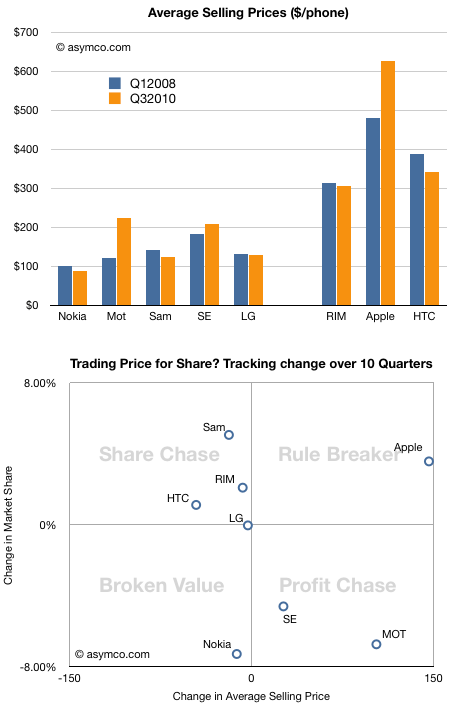
This chart shows the average selling price for all the vendors whose data I maintain over a period of time.


Normally, a drop in price is followed by an increase in share, and an increase in price by a drop in share. To test this hypothesis, I tacked on another chart that shows how share and price have been traded off in the market over the last ten quarters.


Note how prices have dropped for all but three vendors. Two of those vendors (Motorola and Sony Ericsson) have lost share. One, Apple, has gained share. The rest, whose prices did drop, had increases in share, very roughly in proportion to the price drops. Again, we have one exception, Nokia, which suffered both price and share loss.


Except for these two anomalies, the vendors are placed on the -45 degree diagonal that would show expected price elasticity in the market.


I took the liberty of breaking the chart into four quadrants, and gave them names suggesting the strategies of the companies.


Lying along the traditional trade-off axis are either Profit chasing or Share chasing strategies. Anomalies off the axis are either Rule Breakers or Broken Value propositions.


This view of the companies allows us to abstract and think about market evolution.


It would be interesting to think how these players will evolve over time.


It’s quite possible that LG will move into the profit chasing model (as they already indicated they would by building more smartphones). These strategies are typical of companies squeezed from the bottom and the top. I once called this group “the biggest losers” and suggested that they are the best target for Android.


It’s also possible that Nokia will move into the same quadrant, though their profit algorithm favors share above all else.


The biggest question is whether Apple’s rule braking is sustainable. It’s not clear whether they are interested in share as that does not have all that much to do with their definition of “greatness”. But a platform strategy begs for volumes.


This remains the biggest puzzle facing observers of this market.

"

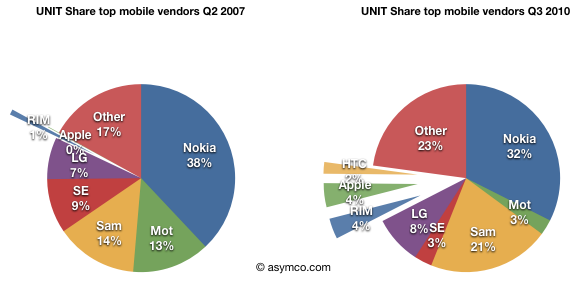
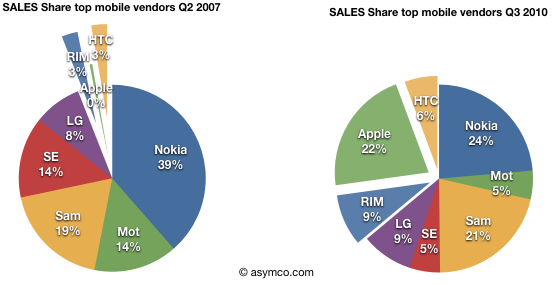
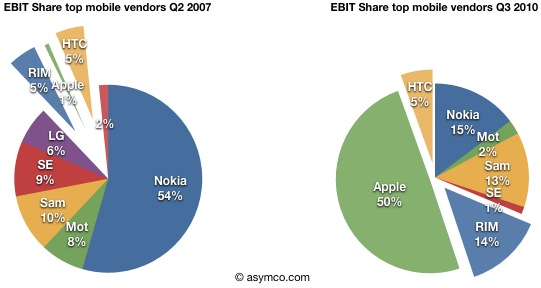
Last quarter Apple obtained 4% unit share, 22% sales value share and 50% of profit share

Last quarter Apple obtained 4% unit share, 22% sales value share and 50% of profit share: "

Pie charts showing 13 quarters of mobile phone market evolution between the largest vendors. Pure play smartphone only vendors are shown with exploded wedges.


The disruption continues.

"