Pages

Live blogging Feed

Tuesday, March 15, 2011

The Race to a Billion

The Race to a Billion: "

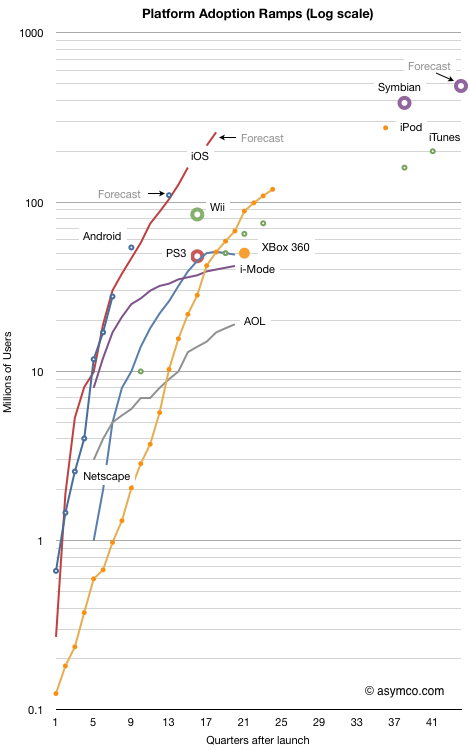
I last looked at the race to a billion in September 2010. I’ve now added a few more data points to the tracked platforms and also added points for the major console game platforms and Symbian.


The chart shows the cumulative number of users (approximated by units sold) for 11 platforms indexed to the same starting date. The horizontal axis is the number of quarters since a platform launched. Every fourth quarter is numbered so each number on the axis represents a new year. The last number on the axis represents 10 years.


The vertical axis is the cumulative number of users on a logarithmic scale. Each number of the vertical axis is 10x more users than the previous number. The top of the graph represents a billion users.


The overall chart shows how quickly a platform has grown and is bounded by a billion users and a decade of usage.


When judging the performance of a platform, the adoption slope and sustainability over time is perhaps the most interesting measure.


One can see how many platforms slow down before reaching 100 million and so far none have hit the billion mark (Windows has but not in the 10 year time frame of this chart.) Looking at game consoles also shows the limits of a narrowly focused platform. They performed better than i-Mode and Netscape but not as well as iTunes or iPod which themselves have growth limits.


If you’re looking for the “fastest growing” title, it’s a toss-up. Both iOS and Android are following almost identical trajectories.[see Notes]


The absolute highest cumulative sales total is Symbian, though now that it’s been deprecated, it’s set to be bypassed.


It does appear that Android and iOS each have the potential to reach a billion users in less than a decade. Perhaps Android will do so faster but the mobile computing platform race will not play out as the personal computing platform race did.


Notes:


  1. For Android I used my own summary data for historic performance except for the last estimate and forecast which came from IMS Research.

  2. iOS forecasts are my own.

  3. Symbian data comes from VisionMobile. Forecast is based on Nokia’s 150 million additional sales prediction.

  4. Game console data is current as of end of 2010 via Wikipedia.

  5. Other data sourced from Morgan Stanley.


"

Monday, March 07, 2011

Who is Winning the U.S. Smartphone Battle? | Nielsen Wire

Who is Winning the U.S. Smartphone Battle? | Nielsen Wire

Sunday, March 06, 2011

Who is Winning the U.S. Smartphone Battle?

Who is Winning the U.S. Smartphone Battle?: "

The answer depends on whether you’re looking at operating systems or manufacturers.


The battle for the hearts and minds of consumer smartphone owners continues to be a heated one according to data just released by The Nielsen Company. When it comes to consumer marketshare by operating system, Android (29%) appears to be pulling ahead of RIM Blackberry (27%) and Apple iOS (27%). But an analysis by manufacturer shows RIM and Apple to be the winners compared to other device makers since they are the only ones creating and selling smartphones with their respective operating systems. HTC follows with 12 percent of consumer smartphone owners having an HTC Android device and 7 percent owning an HTC device running a Microsoft OS. Ten percent of consumer smartphone owners had a Motorola Android device and one percent owned a Motorola device running a Microsoft OS.


manufacture-os-share


Finally, of the three most popular smartphone operating systems, Android seems to attract more young consumers.


smartphone-age-os

"

Android vs. Windows Phone: Which vendors benefit?

Android vs. Windows Phone: Which vendors benefit?: "

Who is Winning the U.S. Smartphone Battle? | Nielsen Wire.


This is a great chart from Nielsen showing the split in manufacturer share by OS in US installed base. What I consider significant is how the modular software platforms Windows Mobile and Android worked out for the licensees.


Whereas in the case of Windows Mobile HTC took a significant, nearly dominant share, the Android ecosystem was more balanced between HTC and Motorola. However, HP and Motorola left the Microsoft camps, Motorola going exclusively for Android and HP buying Palm. That leaves Microsoft with HTC, Samsung and Other (mainly LG I presume).


The question of how Windows Phone will shape up vs. Windows Mobile and Android remains. Motorola has signaled they are not interested in WP7 for the time being and so it’s likely that they will stick with Android. Samsung is always hedging its bets so it will probably balance its portfolio. One could conceive of Nokia stepping into the US with significant WP volumes, but there are many hurdles on the way.


One can see the challenge individual modular vendors have to edge the overall volumes of the integrated vendors. As Nielsen points out:


But an analysis by manufacturer shows RIM and Apple to be the winners compared to other device makers since they are the only ones creating and selling smartphones with their respective operating systems


Not only are the volumes higher, but so are the margins and hence profit share.


"

Monday, February 21, 2011

The lives and deaths of mobile platforms

The lives and deaths of mobile platforms: "

When Stephen Elop said that Nokia and Microsoft sought to create a “three horse race” he implied that there were only two viable mobile ecosystems today. With that statement he sought to deprecate or declare “end of life” two platforms: Symbian and MeeGo, implying that Nokia’s efforts at being the third way failed.


However, he also implicitly declared irrelevant a larger set of market participants. In fact, the market is awash with platforms. Far more than the three or five that Stephen considered.


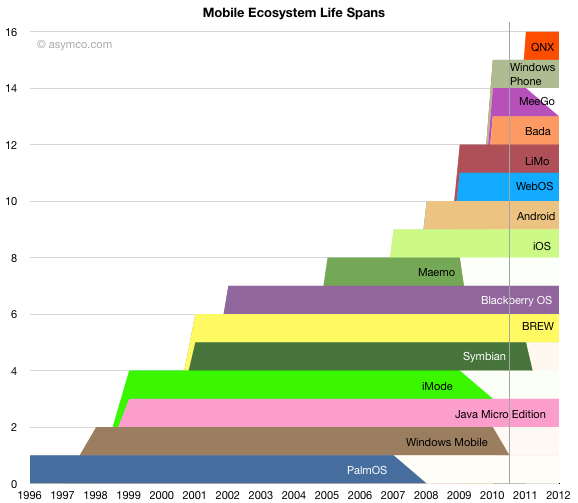
To illustrate I built the following chart showing the history of all major mobile platforms. The are ranked by launch date (earliest at the bottom). A vertical line marks the present. End dates are approximate and based on declarations of end of life rather than end of usage.


There have been 16 total mobile platforms[1], 10 of which are still (or soon will be) on the market. Of the six that were terminated, three had replacements built by the same orchestrating company (Windows Mobile begat Windows Phone; Maemo begat MeeGo, and PalmOS eventually led to WebOS.) Only three reached end of life with no known descendant (iMode, MeeGo[2] and Symbian).


Operating systems that were launched in the 1990s or early 2000s have mostly been withdrawn/replaced with the exception of Java and BREW. ”Modern” operating systems all emerged after 2007 (following iOS). A total of eight such new OSs were introduced in four years[3].


What I find noteworthy is that there is an implied peculiar fatalism about the market when only two platforms are considered viable, neither of which are more than 3 years old. While visiting the Mobile World Congress, I sensed this jumping to conclusions about platforms was eerily similar to that of a few years ago when new entrants like Apple and Google were declared dead on arrival.


I can only conclude that there is a great deal of groupthink going on in the industry. A perfect setting for a disruptive entrant to change everything, all over again.


Notes:


  1. I excluded some platforms like Motorola’s Linux, SavaJe and perhaps some others (Openmoko, Qtopia) which did not gain significant traction. I also excluded any embedded OSs which did not have native APIs.

  2. The end of MeeGo is speculative. Intel is still defending it and may continue developing it.

  3. Android variants like Tapas could be considered new platforms, but I maintain them as part of one OS for the time being.

"

Platform sunk (cost): What is the value of a quarter billion Symbian users?

Platform sunk (cost): What is the value of a quarter billion Symbian users?: "

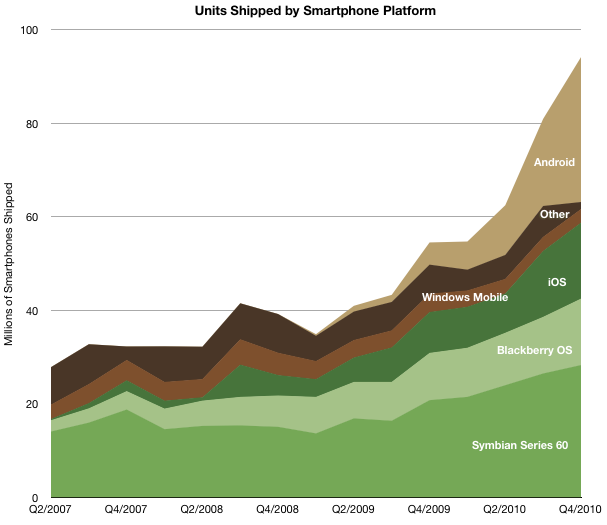
In the quarterly smartphone summary published here, I noted the significant acceleration of Android sales at the expense of “other” and Windows Mobile/Phone. Some share was also lost to Symbian. This might be seen as justification for the “platform jump” that Nokia undertook.


In a second discussion, I published the history and life cycles of the smartphone platforms, identifying 10 platforms (out of 16) still in the market. This challenged the view that it was a two horse race today and that it will become no more than a three horse race in the future.


Questions came up about the “quality” of these platforms. Clearly some are barely viable while some are thriving. To explain the value of a platform, one metric we can use is the cumulative sales which allows us to derive the installed base.


The following charts do just that.


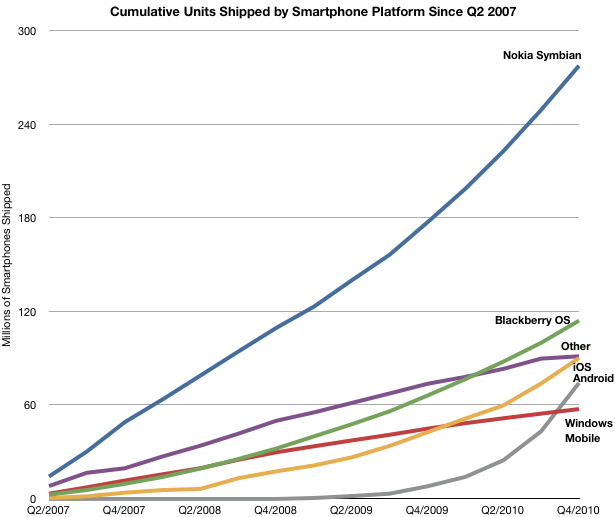
This first chart shows the cumulative total of units sold since Q2 2007. This is the sum of all smartphones sold in the last 3.5 years. There are some interesting patterns here, but right now we want to focus on the installed base.


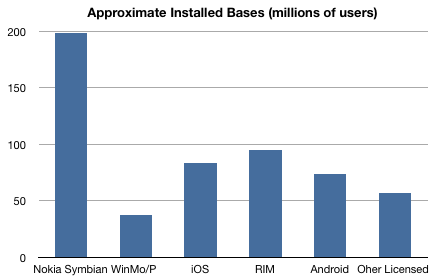
3.5 years of cumulative sales is an upper bound on the installed base. We can get a better estimate the phones in use by subtracting from the base phones older than 2.5 years. This is shown in the second chart below:


As of the last quarter, Nokia’s Symbian is likely to have 200 million in use. Apple may have about 85 million iPhones in use (this excludes iPod touch and iPads) and Android about 75 million. RIM is around 95 million and Windows Mobile less than 40 million.


What’s interesting is that of these installed bases, the largest is the one that’s just been abandoned, and the smallest was chosen as its replacement. Even that’s not quite fair since Windows Mobile is not a valid replacement. It’s Windows Phone that was chosen and that probably has an installed base of about 1 million [Unlike the measurement of units shipped, Microsoft reported two million licenses were sold to OEMs who had to build those into phones which would be shipped to carriers and distributors. One million may be a generous estimate.]


The bottom line is that there are about 5 Windows Phone users for every 1000 Symbian users. In other words, Nokia jumped from the “burning” 200 million user Symbian platform to the “ice cold” 1 million user Windows Phone platform.


The disposal of such a large installed base must count among the largest divestitures in technology history and, when coupled with the adoption of the least-tested alternative as a replacement, elevates platform risk-taking to a new level. It may seem bold, but there is a fine line between courage and recklessness.


I’ll do my own “dive” into the possible justification for this in a future posting.

"

Tuesday, February 15, 2011

GSMA Partners With Zokem at the Biggest Mobile Event of the Year to Report the Latest in Mobile Usage

GSMA Partners With Zokem at the Biggest Mobile Event of the Year to Report the Latest in Mobile Usage: "


GSMA published results from the US and UK based smartphone research study by Zokem at the Mobile World Congress which started today in Barcelona. The report highlights that native apps, boosted by the high number of preinstalled apps and success of various app stores, are overtaking mobile web browser in terms of monthly usage, and are second only to messaging in usage activity.


Barcelona, Spain – February 14, 2011 – GSMA today announced new results from the January 2011 smartphone study by Zokem, shedding some light around the usage of mobile apps and web browsing. The study, which is based on Zokem’s smartphone panels, profiled more than 2 200 smartphone users in the UK and US in January 2011, concluding that messaging related services, including email, text, multimedia, and instant messaging, are still the top smartphone usage category with 671 monthly minutes of usage (active on-the-screen time).


Apps, combining together maps, gaming, entertainment, productivity, and social networking, are close with 667 total monthly usage minutes. Voice (531 minutes) and web browsing (422 minutes) are clearly behind apps and messaging in terms of monthly usage activity.


The report reveals some interesting facts also regarding native apps and web browser usage. News, search and commerce apps and sites receive much more usage still from mobile web browsers, with 86%, 85% and 66% of mobile web browser users using them monthly, respectively. However, only 22% of web browser users access web-based email services, and only 18% use games through a web browser. For email, native apps reach 76% of smartphone users monthly, and games reach 45%.


Multimedia related services, like online music and video, are predominantly used through native apps rather than a smartphone web browser. Adult entertainment, on the other hand, receives practically zero usage from native apps, however, 15% of smartphone users in the UK and US access such sites with the web browser monthly. Apps and web browsing usage patterns, therefore, are quite different, and the usage balance between browsers vs. native apps is driven by the type of app in question.


“These results from our January 2011 news release from the UK and US confirm something that is fundamental for many app developers and advertisers – namely the fact that with smartphones, the web browser is not the only way to access consumers’ attention, but all kinds of native apps from games to business apps, and from maps to social networking, already capture more than 20 minutes of average daily on-screen time from smartphone users, topping, actually, web browser usage. Our report with GSMA is aimed to address these new smartphone usage trends, which are, as we know, changing at an extremely fast phase”, states Hannu Verkasalo, CEO of Zokem.


MWC Daily (Zokem on page 6)


About GSMA


The GSMA represents the interests of the worldwide mobile communications industry. Spanning 219 countries, the GSMA unites more than 750 of the world’s mobile operators, as well as 200 companies in the broader mobile ecosystem, including handset makers, software companies, equipment providers, Internet companies, and media and entertainment organisations. The GSMA is focused on innovating, incubating and creating new opportunities for its membership, all with the end goal of driving the growth of the mobile communications industry. For more information, please visit http://www.gsmworld.com/


About Zokem


Zokem, www.zokem.com is dedicated to providing 360° analytics on the mobile medium; the concept being inspired by the 24-hour human life cycle that Zokem captures through its on-device metering solutions. Zokem pioneers in a new breed of analytics that, ultimately, measures everything that people do in life – not only mobile usage, but also consumer behavior, contexts and trends. Zokem, founded in 2007, runs its global mobile research panels in all major markets and partners with top market research, wireless and Internet companies to interpret the biggest mass medium of the world- mobile.


Media contact:


Meri Kupiainen, +358 45 6337320


press@zokem.com

"

Who will buy the next 150 million Symbian smartphones?

Who will buy the next 150 million Symbian smartphones?: "

Stephen Elop stated that Nokia expects to sell approximately 150 million more Symbian devices before the transition to Windows Phone is complete. Assuming that figure is achievable (which is far from certain) I tried to understand how that figure will affect the volume and share numbers for Nokia in the coming years.


It’s very likely that the first WP phones will not ship in large volumes until 2012. Product development cycles being what they are, unless there is an ODM rebranding (i.e. taking an HTC phone and gluing a Nokia sticker on it) the minimum development time is at least 12 months. Keep in mind that Nokia does not have engineers to build such a product today and hiring them alone can take months.


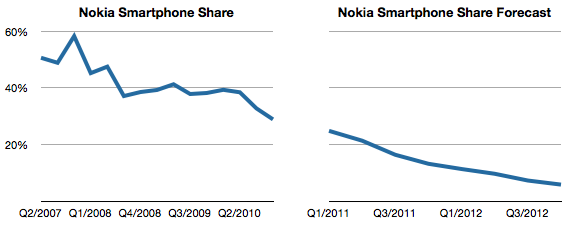
The following two charts show what a two year forecast that adds up to 150 million Symbian devices looks like. I assumed Windows Phones begin to ship in 2012 and, keeping in mind that WP7 is designed for a higher hardware specification than the current Symbian phones, I show a modest ramp for a total of 15 million units in the first year.


I also forecast the overall market assuming continuing growth levels and calculated the effect of Nokia’s share.


The share at the end of 2012 would be approximately 6%.


Note however that the share above depends highly on Nokia selling 150 million Symbian units in the next two years. One could question why would anyone buy a product whose platform that’s been declared end of life. Perhaps there is a built-in assumption that end users are inherently stupid. However even in that scenario the question is which distributors will make the same bet with Nokia? Or, even more perplexing, which operators are willing to stock EOL products for two years when that shelf space is getting strong bids from Nokia’s rivals.

"

Thursday, February 10, 2011

Mobile Megatrends 2011

Mobile Megatrends 2011: "

[We ‘re excited to release our fourth annual Mobile Megatrends 2011 – themed around what else? how software is fundamentally changing the telecoms value chain. In this fourth annual research presentation we take a deep dive into the many facets of change in the mobile industry; the DELL-ification of mobile, the battle for experience ecosystems, apps as web 3.0, the use of open + closed strategies to commodise + protect and how telcos can compete in the age of software.]


After many months in the making, we ‘ve released our annual Mobile Megatrends 2011. It’s our fourth and biggest Megatrends research we ‘ve published to date featuring 68 juicy slides with detailed analysis on the future of mobile.


(want more? Contact us to schedule an on-site Megatrends workshop)


We take a deep dive into how software economics is fundamentally changing the telecoms value chain setting new rules for innovation. We ‘ve broken down the 2011 Megatrends into 8 core themes:


Note: There is a poll embedded within this post, please visit the site to participate in this post's poll.

1. The DELL-ification of mobile: The world of handset OEMs has been irreversibly changed by software and Internet players. All traditional top-5 OEMs (from Nokia to Motorola) that used to enjoy a combined 80% market share in 2008 are now reduced to below 60%, while Internet players are reaping the majority of industry profits and market growth. The OEM market now seems destined to match the shape of the PC manufacturer market, made up of price-led assemblers (Dell, Asus) and performance-led leaders (Apple). For the old guard of top-5 OEMs, the race is on to innovate or die.


2. Software: the new era for telecoms: Besides Android and iOS headline grabbers, more than 30 software platforms have risen and (mostly) fallen in the last decade; Lesson learned: big bucks and software DNA are critical success ingredients for software platforms. The 10 or so remaining software platforms are battling for mass-market smartphone reach below the $100 retail price barrier. At the same time, every major industry player – from telcos to facebook – are striving to grow their own ecosystem, spanning from UI to social networks. However, in the software era of telecoms, not everyone is born equal. Speed of innovation, addressable consumer income and access to a partner ecosystem are all home turf for Internet players, while telecoms incumbents (from Nokia to Vodafone) are taking small, naïve steps. The new rules are: if you can’t innovate in software, you will be replaced sooner than later.


3. The battle for Experience Ecosystems. Convergence between telecoms, PC and Internet has long been talked about. But it’s not about the all-in-one all-powerful smartphone. Convergence is proving to be not about technology, but about experience convergence; how the user experience can ‘roam’ from one screen to the next (phone, PC, TV, mp3 player, etc). Apple is the poster child of experience roaming by consistently integrating the key experience ingredients – from UI and industrial design to an apps ecosystem – across multiple screens. The next battle in mobile is to build experience ecosystems which create user lock-in and cross-sales – and therefore present a sustainable strategy for both handset vendors and telcos to survive commoditisation pressures.


4. Apps are the new web. Everyone wants to compete with their own app store these days, but only a handful of app stores are above the developer radar. Why is creating an app store so hard? Because a successful app store needs 5 unique ‘genes’ from 5 different ‘species’ across the value chain. And thanks to app stores, apps succeed where the web failed; in discovery, personalization and monetization. Apps are in fact a new information paradigm, which the web is adopting. Supported by web benefactors and technology commoditization, web is becoming mainstream application development platform, in what could be could termed the web 3.0.


5. Open + closed: two sides of the same coin. Android took the mobile world by surprise when it launched a free-for-all software platform. But like Qt, MeeGo, WebKit and many other open source projects, ‘open’ is only the tip of the iceberg, since Google et al are using closed governance models to control the direction of the product. Besides open source, ‘openness’ is used as a business strategy to commoditise product complements while closing off other products to protect core assets; in Google’s case commoditizing handset and networks while protecting its own ad network.


6. Developers, the engine behind telecoms innovation. Mobile software developers have come a long way, from back office engineers to front row success stories. However the mobile developer market is still in its infancy. We present a novel way of looking at the developer journey and reveal how most commercial products cater to just a narrow section of that journey, with opportunities abound for catering to the needs and wants of telecom’s innovation engine.


7. Communities: the new currency. Communities are the new frontier for differentiation in the mobile industry. Everyone has tried creating their own communities – from Nokia to Vodafone – but only companies with social DNA have succeeded. Why is that? while you can buy an audience (eyeballs or subscribers), you can’t buy a community (the user interactions). Building a community is a form of art where tools and techniques are being explored, from game mechanics to religion engineering. One thing is certain; that communities are now a core asset in customer attraction and are expanding into communication networks and handsets, with Facebook leading the way.


8. Telcos: stuck in the telecoms age. Telcos are in the midst of an identity crisis and losing control point after control point – location, discovery, billing and authentication – while having no innovation to show in their core voice and messaging business. Yet the real value of telcos is still untapped with micro-billing, customer insights and retailing channels gone largely unexplored. We present 8 novel strategies for telcos and argue why WAC (the telcos’ answer to competing in the software age) is repeating history mistakes and is ultimately misguided.


Want to dive deeper into how software is fundamentally changing the mobile value chain? Contact us to schedule an on-site Megatrends workshop.


Want to reuse the slides within your presentation? Feel free to remix, but please provide attribution to VisionMobile.


Comments welcome!


- Andreas

follow me on twitter: @andreascon


"

Live from HP's WebOS TouchPad Launch

Wednesday, February 09, 2011

Smartphone users still prefer branded phones

Smartphone users still prefer branded phones: "

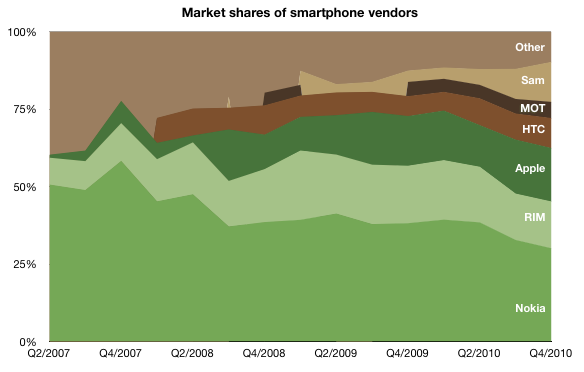
The smartphone market has grown threefold in the span of three years. However, as noted previously, the share of units running a licensed OS has not grown dramatically. The following chart shows the vendors’ shares with the same brown/green dichotomy between licensed and unlicensed OS’s.


In order to gain some insight into this licensed OS area (and who the “others” are) we need some visibility into which OSs are being licensed and what their shares are.


The following chart shows the share of the various licensed platforms[1]. (I blanked out the Integrated vendors.)


Before we dive in to understand the effect of Android, we have to understand the licensing of OSs in 2007.


The chart shows Windows Mobile and “Other” splitting the market. Windows Mobile is rather easy to understand. It was still growing as a platform and Ballmer was famously quoted in 2007 as saying he liked their strategy “a lot”.


But “Other” is something of a mystery. What “Other” actually mostly meant was Symbian[2]. But not only the Symbian that Nokia was shipping and licensing to some vendors. At the time, Symbian also had a version called MOAP “Mobile Oriented Applications Platform” which was in use in Japan (somewhat analogous to the variants of Android now in use in China).


Fujitsu, Mitsubishi, Sony Ericsson and Sharp developed phones for NTT DoCoMo, using an interface developed specifically for DoCoMo’s FOMA “Freedom of Mobile Access” network brand. This UI platform was based on the UI from earlier Fujitsu FOMA models[3]. The user could not install new C++ applications and therefore these were not platform devices, however the industry still included these units as “smartphones” .


So what we’ve witnessed in the last two to three years is the replacement of MOAP and Windows Mobile share with Android TAPAS and OMS.[4]


But, more significantly, when looking at the rise of Samsung and Motorola and HTC we were also witnessing the demise of Palm, Fujitsu, Mitsubishi and Sharp (plus a myriad of Windows Mobile licensees even larger than the Android army).


The significance here is that “other” in smartphones is still mostly about branded vendors. This is in stark contrast to the low-end of the phone market where “others” are quickly replacing branded vendors.


So we can conclude that the smartphone market is so far showing a distinct preference for branded vendors. The value of the brand is still evident. But ZTE and Huawei are quickly developing Android competencies. How long will it be before the branded vendors feel the pressure from the upstarts?


—-


Notes:


  1. The Other category includes WebOS which was not licensed during this time frame but is not material enough in terms of share.

  2. A few million units running flavors of Linux were also on the market in 2007/2008.

  3. FOMA was also implemented with a Linux OS and the same UI.

  4. It should be noted that except for Windows Mobile, all the licensed mobile OSs including LiMO and Symbian are now open source. Android’s success is not therefore due to being the only OS that is “open”.

"

Android and iPhone: Conquistadors or pioneers?

Android and iPhone: Conquistadors or pioneers?: "

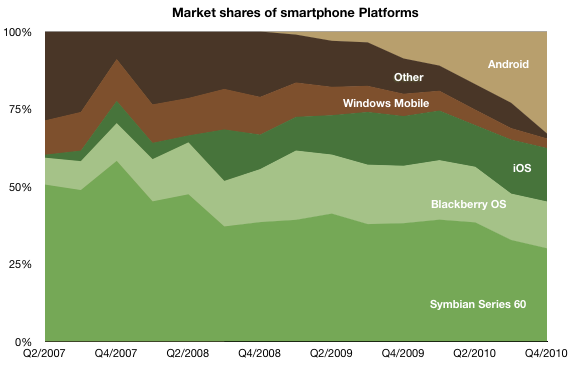
Picking up the discussion of vendor share, I used Canalys estimates of platform shares to visualize the effect of Android on the smartphone market:


Not wishing to belabor the point, but Android and iOS are less than 2 years old as platforms. In that time frame these two johnny-come-latelys have taken 50.2% of the most competitive technology market on the planet.


Here is the share data:


Since the market is not a zero-sum game, I prefer the first chart, but this second view stresses the transition away from incumbent “others” / Windows Mobile toward Android in the licensed OS market.


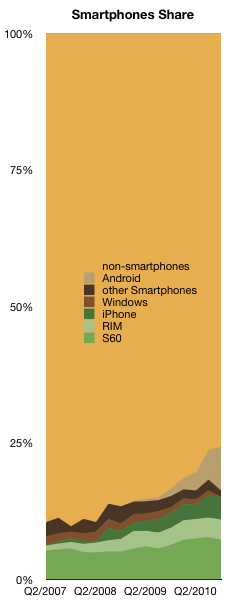
The final chart shows the competition against smartphone non-consumption. I like this chart best of all as it shows the effect of Android in growing the entire pie for smartphones.


What would have happened without Android is anyone’s guess but my bet is that the market would not have grown as quickly. Apple is producing iPhones at capacity and RIM is growing into new markets. Symbian’s strongest markets also do not overlap (much) with Android.


However, the trend seems to be for consolidation of platforms (fragmentation within platforms notwithstanding). This trend, however, is over a very short time span. The smartphone industry started a decade ago and the time frame shown in these charts is a mere 3.5 years.


The question remains whether the headroom visible in this chart still allows for new entrants or whether the platforms we see today are the last we’ll ever see in mobile computing.


I’m still willing to bet that there is room for innovation and for new platforms. Just like the two newcomers that came to conquer half the market emerged seven years after its inception, new contenders like Windows Phone, Bada, MeeGo, WebOS can still make an impact.


The conquerors came with new business models and a focus on computing not telephony. Can factor innovation and the ubiquity of mobile broadband keep this market open to newcomers?

"

Leaked: Nokia’s memo discussing the iPhone, Android, and the need for drastic change

Leaked: Nokia’s memo discussing the iPhone, Android, and the need for drastic change: "

elop1 Leaked: Nokias memo discussing the iPhone, Android, and the need for drastic change

Several days ago it was reported that Nokia’s new CEO, Stephen Elop, published an internal memo that summarized Nokia’s current position in the market and how the Finnish firm was “standing on a platform”. The platform Elop was alluding to was the story of a man who worked on an oil rig and how we was awoken one night by a huge explosion. His rig was on fire, about to collapse, and he had to make a choice: to jump in the frigid sea, in order to save himself and live another day, or be consumed by the flames. That memo has now been leaked, courtesy of Engadget, and we though you’d like to read it for yourself. It’s very powerful stuff, so please don’t go tl;dr on this block of text. Read it, read it again, and then think about what Nokia might announce on Friday when Elop reveals his plan to turn the ship back on track. I’ve highlighted key sentences by making them bold.

Hello there,

There is a pertinent story about a man who was working on an oil platform in the North Sea. He woke up one night from a loud explosion, which suddenly set his entire oil platform on fire. In mere moments, he was surrounded by flames. Through the smoke and heat, he barely made his way out of the chaos to the platform’s edge. When he looked down over the edge, all he could see were the dark, cold, foreboding Atlantic waters.

As the fire approached him, the man had mere seconds to react. He could stand on the platform, and inevitably be consumed by the burning flames. Or, he could plunge 30 meters in to the freezing waters. The man was standing upon a “burning platform,” and he needed to make a choice.

He decided to jump. It was unexpected. In ordinary circumstances, the man would never consider plunging into icy waters. But these were not ordinary times – his platform was on fire. The man survived the fall and the waters. After he was rescued, he noted that a “burning platform” caused a radical change in his behaviour.

We too, are standing on a “burning platform,” and we must decide how we are going to change our behaviour.

Over the past few months, I’ve shared with you what I’ve heard from our shareholders, operators, developers, suppliers and from you. Today, I’m going to share what I’ve learned and what I have come to believe.

I have learned that we are standing on a burning platform.

And, we have more than one explosion – we have multiple points of scorching heat that are fuelling a blazing fire around us.

For example, there is intense heat coming from our competitors, more rapidly than we ever expected. Apple disrupted the market by redefining the smartphone and attracting developers to a closed, but very powerful ecosystem.

In 2008, Apple’s market share in the $300+ price range was 25 percent; by 2010 it escalated to 61 percent. They are enjoying a tremendous growth trajectory with a 78 percent earnings growth year over year in Q4 2010. Apple demonstrated that if designed well, consumers would buy a high-priced phone with a great experience and developers would build applications. They changed the game, and today, Apple owns the high-end range.

And then, there is Android. In about two years, Android created a platform that attracts application developers, service providers and hardware manufacturers. Android came in at the high-end, they are now winning the mid-range, and quickly they are going downstream to phones under €100. Google has become a gravitational force, drawing much of the industry’s innovation to its core.

Let’s not forget about the low-end price range. In 2008, MediaTek supplied complete reference designs for phone chipsets, which enabled manufacturers in the Shenzhen region of China to produce phones at an unbelievable pace. By some accounts, this ecosystem now produces more than one third of the phones sold globally – taking share from us in emerging markets.

While competitors poured flames on our market share, what happened at Nokia? We fell behind, we missed big trends, and we lost time. At that time, we thought we were making the right decisions; but, with the benefit of hindsight, we now find ourselves years behind.

The first iPhone shipped in 2007, and we still don’t have a product that is close to their experience. Android came on the scene just over 2 years ago, and this week they took our leadership position in smartphone volumes. Unbelievable.

We have some brilliant sources of innovation inside Nokia, but we are not bringing it to market fast enough. We thought MeeGo would be a platform for winning high-end smartphones. However, at this rate, by the end of 2011, we might have only one MeeGo product in the market.

At the midrange, we have Symbian. It has proven to be non-competitive in leading markets like North America. Additionally, Symbian is proving to be an increasingly difficult environment in which to develop to meet the continuously expanding consumer requirements, leading to slowness in product development and also creating a disadvantage when we seek to take advantage of new hardware platforms. As a result, if we continue like before, we will get further and further behind, while our competitors advance further and further ahead.

At the lower-end price range, Chinese OEMs are cranking out a device much faster than, as one Nokia employee said only partially in jest, “the time that it takes us to polish a PowerPoint presentation.” They are fast, they are cheap, and they are challenging us.

And the truly perplexing aspect is that we’re not even fighting with the right weapons. We are still too often trying to approach each price range on a device-to-device basis.

The battle of devices has now become a war of ecosystems, where ecosystems include not only the hardware and software of the device, but developers, applications, ecommerce, advertising, search, social applications, location-based services, unified communications and many other things. Our competitors aren’t taking our market share with devices; they are taking our market share with an entire ecosystem. This means we’re going to have to decide how we either build, catalyse or join an ecosystem.

This is one of the decisions we need to make. In the meantime, we’ve lost market share, we’ve lost mind share and we’ve lost time.

On Tuesday, Standard & Poor’s informed that they will put our A long term and A-1 short term ratings on negative credit watch. This is a similar rating action to the one that Moody’s took last week. Basically it means that during the next few weeks they will make an analysis of Nokia, and decide on a possible credit rating downgrade. Why are these credit agencies contemplating these changes? Because they are concerned about our competitiveness.

Consumer preference for Nokia declined worldwide. In the UK, our brand preference has slipped to 20 percent, which is 8 percent lower than last year. That means only 1 out of 5 people in the UK prefer Nokia to other brands. It’s also down in the other markets, which are traditionally our strongholds: Russia, Germany, Indonesia, UAE, and on and on and on.

How did we get to this point? Why did we fall behind when the world around us evolved?

This is what I have been trying to understand. I believe at least some of it has been due to our attitude inside Nokia. We poured gasoline on our own burning platform. I believe we have lacked accountability and leadership to align and direct the company through these disruptive times. We had a series of misses. We haven’t been delivering innovation fast enough. We’re not collaborating internally.

Nokia, our platform is burning.

We are working on a path forward — a path to rebuild our market leadership. When we share the new strategy on February 11, it will be a huge effort to transform our company. But, I believe that together, we can face the challenges ahead of us. Together, we can choose to define our future.

The burning platform, upon which the man found himself, caused the man to shift his behaviour, and take a bold and brave step into an uncertain future. He was able to tell his story. Now, we have a great opportunity to do the same.

Stephen.
Leaked: Nokia’s memo discussing the iPhone, Android, and the need for drastic change was originally published on IntoMobile. Copyright © 2005-2011 IntoMobile. Use of this feed is limited to personal use. tvefFb3nZgqz


"

Monday, February 07, 2011

Developer Economics 2011: The evolution of app development

Developer Economics 2011: The evolution of app development: "

[Developer Economics 2011 is here! As we launch our new survey on all things developer-related, Marketing Manager Matos Kapetanakis looks back at the 2010 report and examines the major events that have shaped mobile development in the past 6 months]


VisionMobile - Developer Economics 2011


The evolution of Developer Economics

Last July we published the definitive mobile developer research report: Developer Economics 2010, dubbed by TechCruch as “one of the most profound…to date”. Our report delved into all aspects of mobile application development, across a sample of 400+ developers segmented into eight major platforms.


We’ve just launched the follow-up to this research report: Developer Economics 2011, once again made possible thanks to BlueVia, the global developer platform from Telefonica that helps developers take apps, web services and ideas to market. Our goal is to see how the dynamics of the developer world have changed since early 2010 and to provide more insights into app marketing, monetization and many other factors.


Join the survey or help spread the word! This year we ‘ve also secured a prize for each of the first 400 developers; 10 hours free testing time on DeviceAnywhere’s 2000+ handsets. UPDATE: Thanks to overwhelming support, all 400 free testing time prizes have been awarded by DeviceAnywhere. Of course, the $1,500 Amazon voucher is still up for grabs!


Major shakeups of the mobile industry for H2 2010

So, what’s changed since our 2010 research? The mobile industry is an ever-evolving landcape. In the past 6 months we have seen the Symbian Foundation close shop, with Nokia hoping that the as-yet untested MeeGo project will carry their smartphone banner. We have also seen the stellar rise of Android, zooming past Apple’s iOS and BlackBerry and becoming the no2 smartphone platform behind Symbian.


In the handset OEM arena, we have seen more shakeups in 2010 alone than in the 10 years preceding it. Apple and RIM have overtaken some of the traditional handset OEM powers (Sony Ericsson, Motorola, LG) and claimed a spot in the top 5. According to some estimates, ZTE could join them soon.


Moving forward, Developer Economics 2011 is looking at how the key metrics of mobile development have changed in the last year.


The migration of developer mindshare

One of the major findings of our 2010 report was the migration of developer mindshare away from the ‘old guard’, i.e. Symbian, BlackBerry and Java, towards the new powers of the realm – iOS and Android. According to our research, nearly 60% of the 400+ respondents had developed apps on Android. Apple’s iOS took second place, with more than 50% of respondents having a go at it, with Java ME following third.


In our Developer Economics 2011 research, we’ll be asking participants which platforms they’re currently targeting, which ones they plan on targeting and which ones they’re abandoning.


So, what’s changed since then? Well, if anything, the gap between Android and iOS and the rest of the platforms has grown even larger. The Apple App Store carries more than 300 thousand apps, while recent estimates place the number of apps in Android Market at around 130 thousand.


While Nokia has been spending considerable effort on the Ovi Store and increased its popularity with consumers and developers alike, they still have a long way to go to catch up with the two app-dispensing behemoths.


Why do developers head towards iOS and Android? Our Developer Economics 2010 analysis showed that Apple offers a platform that is relatively easy to master and using which a developer can design great UIs. They also have the largest app store and although the certification problem is an issue for some, porting and fragmentation are not a challenge;. Android, on the other hand, has been gaining momentum across all fields, storming its competitors’ key market – the US. Of course, Android’s many fragmentation issues are often overlooked in the face of many handset OEMs’ dependency on the platform.


The disparity between handset sales and available apps


Our Developer Economics 2010 research uncovered a disparity between the number of devices sold for each platform and the number of available apps. One would expect the platforms with the highest market penetration to dominate in terms of apps, but that couldn’t be further from the truth.


Taking 3Q10 as a reference, it’s easy to see that the two platforms with the lowest penetration, iOS and Android, have the highest number of available apps.


On the opposite side of the spectrum, while Java ME and Flash Lite have the greatest market penetration by far, they can scarcely measure up to the newer platforms when it comes to app volumes.


In Q4, the contrast is even sharper. Both Android and iOS stores have grown by almost 100 thousand apps apiece. Windows Phone has shown an admirable growth, reaching 4 thousand apps in just two months, although it still has a long way to go before becoming truly a threat to incumbents.


Monetization and revenue expectations


In Developer Economics 2010, we asked developers how they felt about the revenues they’re receiving from selling their apps. Almost one in four respondents reported poor revenues, while only 5% reported revenues exceeding their expectations.


VisionMobile - Developer Economics 2010 - revenue expectations


While there has been a boom of app stores, that’s not necessarily a blessing for developers. Most developers face a discoverability issues, having their apps buried under thousands of other apps. Like one developer said in our previous research “It’s like going to a record store with 200,000 CDs. You ‘ll only look at the top-10″.


What options are there for developers? One option is to adopt a multiple storefront strategy, as well as to tailor your monetization model to specific app stores. As the CEO of Rovio, creator of the prodigious Angry Birds app, noted: “Free is the way to go with Android. Nobody has been successful selling content on Android”.


Developing apps in 2011

Care to see how the apps world has changed in the last year? Stay tuned for Developer Economics 2011, where we delve into app development, monetization, distribution, retailing, porting and fragmentation issues among many others.


Mobile developer? Join the survey and have your say.


"

iPhone and iPad: Fine Young Cannibals?

iPhone and iPad: Fine Young Cannibals?: "

The iPad and iPhone came, saw and conquered new markets. But since the products launched the question on every analyst’s mind has been on how much have these products “cannibalized” their brethren the iPod and the Mac.


This notion of “cannibalization” applies when a product is designed to compete and “eat” the share of another product in a company’s portfolio. It has some negative connotations since it implies loss but many times the thinking is that it’s better to cannibalize oneself rather than have it done by a competitor.


But have iPhone and iPad taken share from their competitors?


The following charts compare the total units of iPhones vs. iPods and iPads and iPads vs. Macs.


The evidence does not show cannibalization.


Although both iPhone and iPad have crossed over and are selling more units than their internal competitors, the old guard has not faded away.


Indeed, the Mac shows resilience and the iPod, although not growing in units has maintained sales value. What we don’t see is a clear gain for the entrants at the expense of the incumbents.


We can’t be sure how long this happy co-habitation will last, but for now the new products are fine and young but not cannibals.

"

Mobile phone vendor share update. Biggest winner: Other

Mobile phone vendor share update. Biggest winner: Other: "


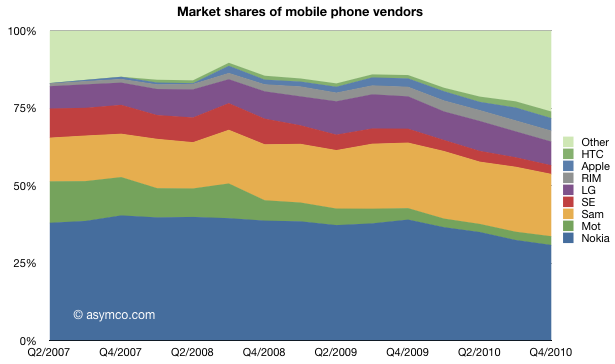
Biggest share winner: Other.


The trend toward ZTE, Huawei and others taking volume share from the traditional incumbents continues. Smartphones continue to capture value share. Dedicated smartphone vendors HTC, RIM and Apple would make up the third biggest single vendor, starting from a very small base.


Looking over this three and a half year period, the change in the market is quite dramatic.

"

Samsung was the fastest growing major smartphone vendor

Samsung was the fastest growing major smartphone vendor: "

The smartphone market grew 73% in Q4. Here are the growth rates for vendors which regularly report smartphone sales:


  • HTC: 142%

  • Motorola: 96%

  • Apple: 86%

  • RIM: 40.5% (period ending November)

  • Nokia: 36%


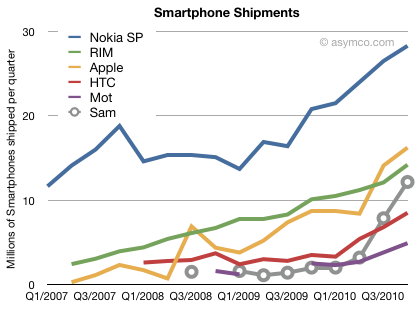
Samsung is not consistent in reporting smartphones and we don’t have year-ago data but the following chart can be used to get a hint.


Samsung had a very good year with 25.2 million smartphones sold. This is compared to 2009 when they probably sold less than 5 million. Their growth has meant they overtook both Motorola and HTC and are likely to overtake RIM this year.


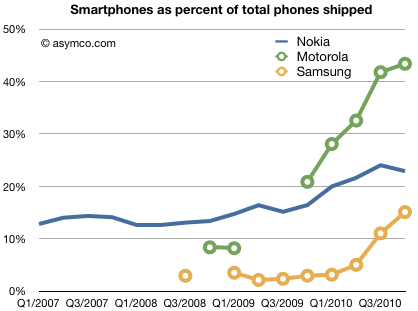
Samsung owes its success mainly to adopting Android. As can be seen in the next chart, Samsung moved rapidly to shift its portfolio from non-smart to smart. This is quite a feat considering the starting point well below that of Nokia.


From 2% of total phones to 15% smartphone volumes in 18 months is astonishing.


Extrapolating for the missing data leads to an estimate of smartphone growth for Samsung of over 500%.

"

Making it up in volume: How profit and volumes traded-off in the fourth quarter

Making it up in volume: How profit and volumes traded-off in the fourth quarter: "

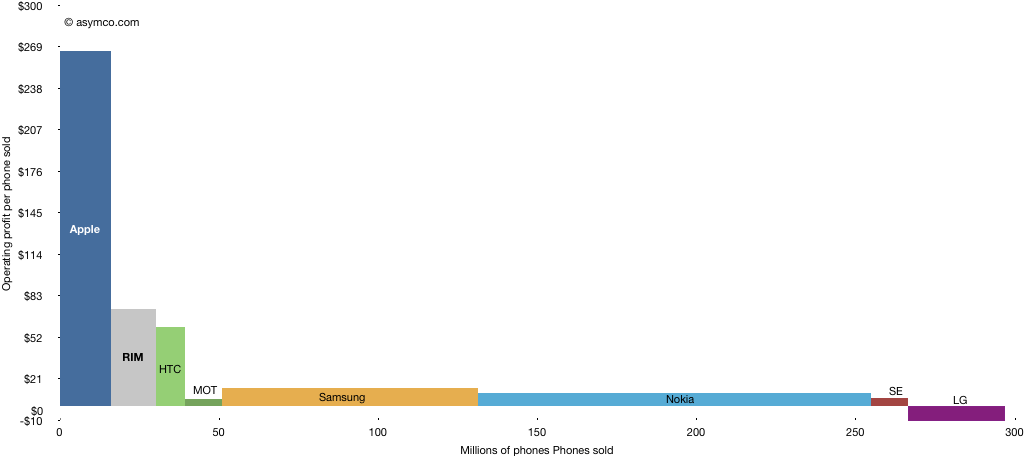
Today’s charts show the amount of profit captured by the top eight public mobile phone companies in two different ways.


The first, as a bar chart:


The second shows the way they captured it by taking into consideration the number of devices sold.


Please click on the image for a full size view (1024 pixels wide).


Generally speaking, vendors which are focused on smartphones have higher pricing and higher profitability (pricing discussion will follow at a later time). However, some, like Motorola and Sony Ericsson are still trying to recover from the collapse of their non-smartphone business and have higher prices but not very high margins overall. LG does not seem far behind.


Samsung and Nokia profit per device is quite small but they “make it up in volume”.


The areas above represent operating profits and are comparable. One wonders how the ratios between horizontal and vertical dimensions for these boxes will change over time.


Since the overall market will expand, the sum of all horizontal dimensions will increase. As the first chart shows, there is no law for the conservation of profits in the industry, so it’s possible that the sum of all these areas will increase, but it’s still hard to imagine it increasing by an order of magnitude.


Will the industry remain clustered into a tall-and-narrow group and a short-but-wide group? That’s a question with many strategic implications..

"